Climate & development
For poorer countries, climate change and development are the same problem. Floods, droughts and heat undo progress, and the energy systems they build now will determine future emissions. Most of Germany's budget-funded international climate finance runs through the BMZ.
2024 figures published on 30 Sep 2025 by the Federal Environment Ministry (bundesumweltministerium.de). Figures for 2025 had not been found published at the time of writing.
The vocabulary of climate and development
Climate finance
Public and mobilised private money for climate action in developing countries. Developed countries' pledges are counted under the UN climate convention.
Adaptation
Preparing for impacts that can no longer be avoided: water management, drought-resistant agriculture, early warning, social protection.
Mitigation
Reducing emissions through renewable energy, efficiency, forest protection and sustainable transport.
Energy transition
Partnerships such as Indonesia's JETP combine coal phase-down, grid expansion and social measures for affected workers.
Climate justice
The countries least responsible for emissions are often the most exposed. This argument shapes negotiations on finance and loss and damage.
Sustainable infrastructure
Ports, power, water and housing built now will last for decades, so standards matter for both resilience and emissions.
Commitments and constraints
- 2–3 Jun 2025
Hamburg Sustainability Conference
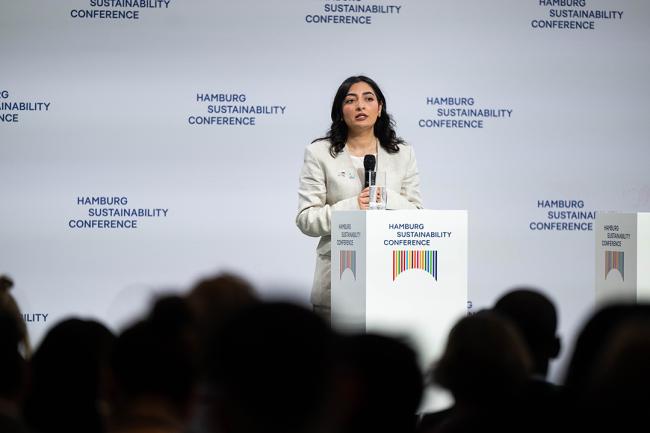
Keynote at the second edition, with about 1,600 participants. The conference adopted a Hamburg Declaration on responsible AI for the Sustainable Development Goals.
- 5–7 Nov 2025
COP30, Belém
Germany committed €1 billion over ten years to the Tropical Forest Forever Facility, together with the Environment Ministry.
- 29–30 Jun 2026
Hamburg Sustainability Conference 2026
The third edition launched a South-North Commission, and she handed over a UN80 action plan.
- Aug 2026
Indonesia
Renewable energy and grids as development cooperation. See case study.
- 2027 draft
Budget pressure
The 2027 draft adds €178.6 million from the Climate and Transformation Fund to the BMZ. Overall, though, the ministry's budget falls, and Germany's ODA ratio is projected to decline. Whether the €6 billion climate finance pledge can be met in future years is an open question.
This page reports policy and figures. It does not campaign for any position. Criticism that budget cuts endanger climate commitments, raised by NGOs in the 2026 budget debates, is recorded on the criticism page.
- Federal Environment Ministry, climate finance 2024: bundesumweltministerium.de
- BMZ, HSC keynote 2025: bmz.de; UNDP, HSC 2025: undp.org
- Bundestag on COP30 / TFFF: bundestag.de
- IISD on the NCQG (COP29): sdg.iisd.org
- Bundestag hib 655/2026: bundestag.de